

How Backup Power Strengthens Critical Infrastructure
Electrical Engineering Solutions
Public Sector
2 months
Critical infrastructure requires sustainable operation regardless of external circumstances. It is particularly important when even a short-term equipment shutdown can affect the provision of services to residential areas, businesses, and social institutions.
Compass Engineering, in cooperation with Cummins and IWT, implemented a backup power supply and automation project in Sumy region. The primary objective was to improve the resilience of facilities to power supply disruptions and enhance equipment control.
Before the project began, the infrastructure faced several interrelated challenges.
Frequent power outages created a risk of complete equipment shutdown. Without a backup power source, restoring equipment operation depended on the stabilization of the external power grid, which could lead to service interruptions.
Another challenge was manual control. Switching operating modes, regulating loads, and starting backup systems required continuous staff involvement. It increased time requirements, created a risk of human error, and made it more difficult to respond promptly to changing operating conditions.
The need to integrate new equipment with existing engineering systems became an additional challenge. Devices already had operational mechanical and electrical components, so modernization required the preliminary assessment, compatibility checks, and configuration of control systems without disrupting facility operations.
The project involved developing a comprehensive solution combining backup power supply and automation.
Key objectives included:
- Ensuring backup power for critical equipment
- Reducing service interruptions during emergency power outages
- Automating equipment control
- Optimizing operating modes and energy consumption
- Reducing reliance on manual operations
- Improving infrastructure control
- Adapting the solution to the facilities’ existing engineering systems
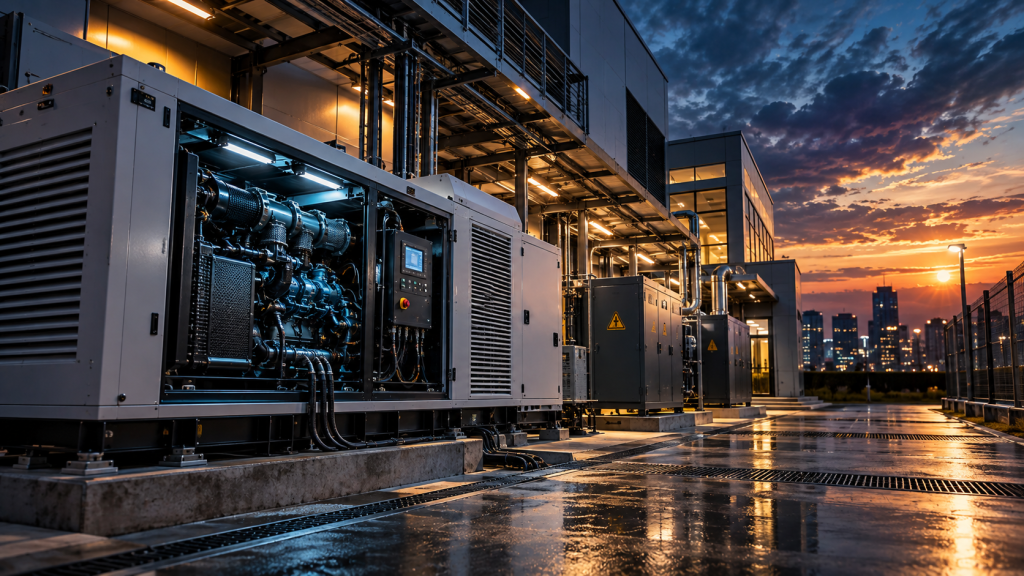
Cummins diesel generator sets were supplied to provide backup power. They were designed for operation under demanding reliability and power continuity requirements.
The second key component of the project was automated control cabinets. They allowed shifting from manual control to more controlled and predictable equipment operation.
The automated system ensures:
- Equipment control based on current load requirements
- Regulation of equipment operating modes
- Optimization of electricity consumption
- Reduction in the number of manual operations
- Faster response to emergencies
- Interaction with the backup power system
Combining generator sets with automated control made it possible to treat power supply and equipment operation as a single integrated system rather than two separate tasks.
The implementation consisted of several key stages:
One analyzed the electrical and mechanical infrastructure, as well as defined backup power and automation requirements.
The solution package was based on the facilities’ power requirements, operating conditions, and integration capabilities with existing systems.
Transporting large-scale diesel generator sets to facilities in Sumy region required advance planning, specialized equipment, and coordination of installation activities.
One installed generator equipment and automated control cabinets, as well as connected the new components to the existing infrastructure.
Equipment operation was tested in both normal and backup modes, including system interaction and correct power switching.
Facility personnel received the necessary knowledge to operate the new equipment and work with the automated control systems.
Despite technical and logistical constraints, all works were completed within the agreed deadline – in two months.
As a result of the project, the equipment gained additional protection against power supply disruptions and more advanced control capabilities.
Critical facilities were provided with backup power
Transfer to the backup power source was reduced to just a few seconds
The risk of prolonged equipment downtime was reduced
Equipment control and individual operations previously performed manually were automated
Control over infrastructure operating modes was improved
Conditions were created for more efficient use of electricity
The personnel workload was reduced
The predictability of facility operation and maintenance was improved
The automation also provided a foundation for further development of the system, including the introduction of additional monitoring functions, remote control, and real-time access to equipment status information.
The solution implemented in Sumy region can be adapted to other critical infrastructure facilities where autonomy, rapid recovery of operations, and energy consumption control are essential.
Depending on the specific requirements of a facility, the system can be expanded with extramonitoring and remote control capabilities. This approach allows modernizing infrastructure gradually, taking into account the technical condition of the equipment, available budget, and priority of individual processes.
“This project brought together the reliability of power equipment, automation, and a flexible engineering approach. As a result, critical facilities gained additional capabilities for sustainableoperation under unstable power supply conditions, while personnel obtained more efficient tools for infrastructure management,” Oleksii Trofymenko, the Head of Electrical Engineering Solutions at Compass Engineering, said.
The resilience of critical infrastructure is not achieved through a single technical solution but through the coordinated operation of power systems, automation, and operational processes. It is this comprehensive approach that enables infrastructure facilities to better adapt to unstable conditions and maintain controllability even when common operating scenarios are disrupted.